
Introduction to IPL Match Prediction (2026 Guide)
The Indian Premier League has evolved into one of the most exciting and competitive cricket leagues in the world. With millions of fans watching every match, the demand for accurate IPL match prediction has grown rapidly in recent years. From fantasy cricket players to sports analysts, everyone is now looking for reliable ways to predict match outcomes and gain an edge.
In 2026, IPL match prediction is no longer based on guesswork. It has become a combination of data analysis, player performance tracking, pitch reports, and real-time match insights. With the rise of advanced tools and analytics platforms, predicting IPL matches has transformed into a strategic skill that anyone can learn and master.
At its core, IPL match prediction involves evaluating multiple factors before and during a match. These include team strength, player form, venue conditions, toss decisions, and even weather patterns. Each of these elements plays a crucial role in determining the final outcome of a game. Ignoring even one factor can lead to inaccurate predictions, which is why professional analysts take a comprehensive approach.
One of the main reasons IPL prediction has become so popular is the growth of fantasy cricket platforms. Users now rely heavily on match predictions to create winning teams and maximize their chances of success. A correct prediction not only boosts confidence but also enhances overall gameplay strategy. This has encouraged fans to go beyond basic knowledge and start understanding cricket at a deeper level.
Another important aspect of IPL match prediction is the availability of real-time data. Today, you can access detailed statistics such as player averages, strike rates, bowling economy, head-to-head records, and venue performance within seconds. This data helps users make informed decisions rather than relying on emotions or personal bias. For example, a team may look strong on paper, but recent performance data might reveal weaknesses that could impact the match.
Technology has also played a major role in improving prediction accuracy. Artificial Intelligence (AI) and machine learning models are now being used to analyze past matches and identify patterns. These systems can process thousands of data points quickly and provide insights that are difficult for humans to detect. While these tools are not always 100% accurate, they significantly increase the chances of making correct predictions.
However, it is important to understand that no prediction method can guarantee results. Cricket is an unpredictable sport, and unexpected moments—such as a sudden batting collapse or an outstanding individual performance—can change the course of a match instantly. That’s why successful predictors always combine data analysis with practical cricket knowledge and intuition.
For beginners, IPL match prediction may seem complex at first, but with the right approach, it becomes much easier. Start by focusing on basic factors like team form and key players. Gradually, you can move on to advanced elements such as pitch behavior, toss impact, and match conditions. Over time, your ability to analyze matches will improve, and your predictions will become more accurate.
Consistency is the key to success in IPL prediction. Instead of making random guesses, develop a structured approach and follow it for every match. Keep track of your predictions, learn from mistakes, and continuously update your knowledge based on new trends and data. This will help you build confidence and improve your overall success rate.
In conclusion, IPL match prediction in 2026 is a powerful blend of strategy, statistics, and smart decision-making. Whether you are a beginner or an experienced cricket fan, understanding the fundamentals of prediction can enhance your IPL experience significantly. As the league continues to grow, so does the importance of accurate and data-driven predictions—making it an essential skill for every modern cricket enthusiast.
How IPL Match Prediction Works (Step-by-Step Guide 2026)

Understanding how IPL match prediction works is essential if you want to move from basic guessing to accurate, data-driven decisions. The Indian Premier League is one of the most dynamic cricket tournaments, where multiple variables influence the outcome of every match. In 2026, prediction methods have become more advanced, combining statistical models, expert analysis, and real-time match insights.
In this section, we will break down the complete working process of IPL match prediction in a simple step-by-step format so that even beginners can understand and apply it effectively.
🔍 Step 1: Pre-Match Research & Team Analysis
The first step in IPL match prediction begins before the match even starts. This includes studying both teams in detail.
You should analyze:
- Recent performance (last 5 matches)
- Team balance (batting vs bowling strength)
- Key players’ current form
- Injuries or player availability
For example, if a team has strong top-order batsmen but weak bowlers, they may struggle to defend a score. Similarly, a team with in-form bowlers may dominate on a bowling-friendly pitch.
This step builds the foundation of your prediction.
📊 Step 2: Player Statistics & Performance Metrics
Once team analysis is complete, the next step is to evaluate individual player performance.
Important metrics include:
- Batting average and strike rate
- Bowling economy and wickets taken
- Performance against specific opponents
- Performance at a particular venue
Modern IPL prediction relies heavily on these numbers. For instance, some players perform exceptionally well at certain stadiums, while others struggle under pressure situations.
By combining these insights, you can identify:
✔ Key match-winners
✔ Players likely to fail
✔ Hidden performers
🏟️ Step 3: Pitch Report & Ground Conditions
The pitch plays a decisive role in IPL match prediction. Every stadium in the IPL behaves differently, and understanding pitch conditions can significantly improve your accuracy.
Types of pitches:
- Batting pitch → High-scoring matches
- Bowling pitch → Low scores, more wickets
- Spin-friendly pitch → Advantage for spinners
- Pace-friendly pitch → Helps fast bowlers
Additionally, factors like ground size, boundary dimensions, and outfield speed also impact scoring patterns.
Ignoring pitch conditions is one of the biggest mistakes beginners make.
🌦️ Step 4: Weather & Dew Factor Analysis
Weather conditions directly affect match outcomes, especially in night matches.
Key factors:
- Dew → Makes it difficult for bowlers to grip the ball
- Humidity → Impacts swing bowling
- Wind → Affects big hitting and fielding
In many IPL matches, teams prefer chasing because dew makes batting easier in the second innings. This is why weather analysis is crucial in IPL match prediction.
🪙 Step 5: Toss Impact on Match Outcome
The toss is often a game-changing factor in IPL matches.
Why toss matters:
- Teams choose batting or bowling based on pitch
- Chasing teams often have an advantage due to dew
- Some teams perform better when batting first
A strong prediction always considers two scenarios:
- If Team A wins the toss
- If Team B wins the toss
This approach increases your prediction accuracy significantly.
📈 Step 6: Head-to-Head & Historical Data
Another important step is analyzing past encounters between teams.
Look at:
- Head-to-head win records
- Performance at the same venue
- Past match situations
Sometimes, one team consistently dominates another due to strategy or psychological advantage. This trend can help refine your prediction.
🧠 Step 7: Live Match Reading & In-Game Prediction
Prediction doesn’t stop after the match starts. In fact, live prediction is even more powerful.
During the match, analyze:
- Powerplay performance
- Required run rate vs current run rate
- Wickets in hand
- Momentum shifts
For example, losing early wickets in a chase can drastically reduce winning chances, even if the required run rate looks manageable.
🤖 Step 8: Use of AI & Prediction Tools
In 2026, many platforms use AI-based prediction systems that analyze:
- Thousands of past matches
- Player performance patterns
- Real-time match conditions
These tools provide:
✔ Win probability percentages
✔ Suggested outcomes
✔ Risk analysis
While AI improves accuracy, it should always be combined with human understanding for best results.
🎯 Key Factors for Accurate IPL Match Prediction (2026 Strategy Guide)
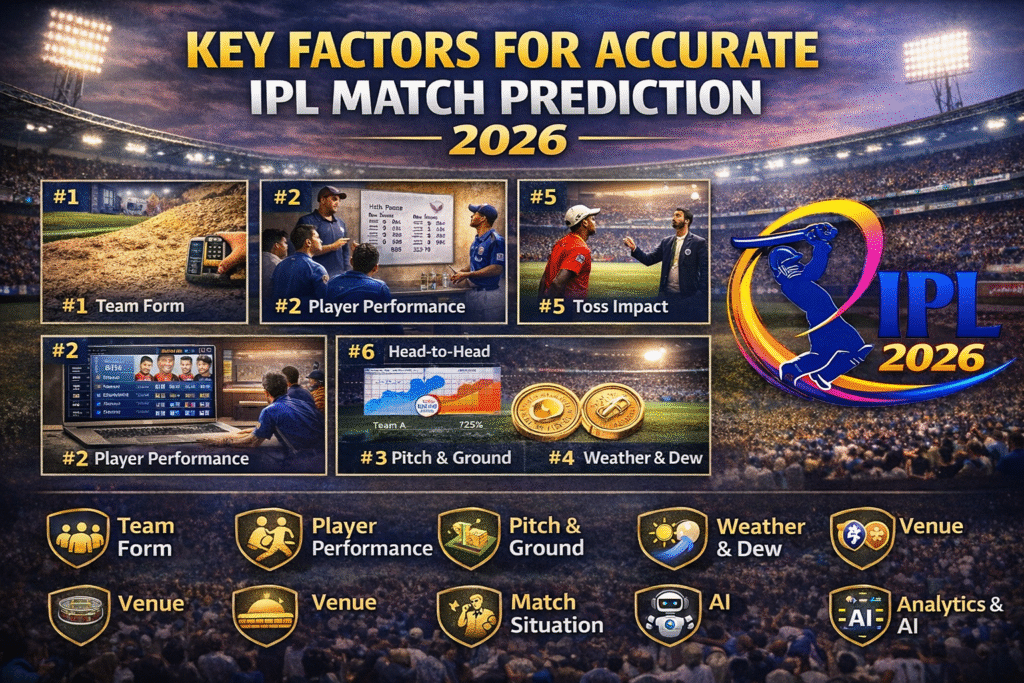
When it comes to making accurate predictions in the Indian Premier League, understanding the key factors is absolutely essential. Many beginners rely on guesswork or emotional bias, but professional predictors follow a structured approach based on data, match conditions, and cricket intelligence. In this section, we will break down the most important factors that directly impact IPL match outcomes and help you improve your prediction accuracy in 2026.
📊 1. Team Form & Momentum
One of the most crucial factors in IPL match prediction is team form. A team that has been consistently winning matches carries confidence and momentum, which often translates into better performance on the field.
Things to analyze:
- Last 4–5 match results
- Winning or losing streak
- Performance under pressure
- Net run rate trends
A team in good form usually performs better than a stronger team that is struggling. Momentum plays a psychological role, especially in high-pressure tournaments like IPL.
🧑🤝🧑 2. Player Form & Key Performers
Individual player performance can completely change the outcome of a match. Even one exceptional innings or bowling spell can turn the game around.
Focus on:
- Top-order batsmen consistency
- Finishers’ ability in death overs
- Strike bowlers’ wicket-taking ability
- All-rounders’ impact
For example, if a team has multiple in-form players, their chances of winning increase significantly. On the other hand, if key players are out of form, it weakens the team structure.
🏟️ 3. Pitch Report & Ground Conditions IPL match prediction
The pitch is one of the most underrated yet powerful factors in IPL prediction. Each stadium has a unique pitch behavior that affects scoring patterns.
Types of pitch:
- Batting-friendly → High scores (180+)
- Bowling-friendly → Low scoring matches
- Spin-friendly → Advantage for spinners
- Pace-friendly → Supports fast bowlers
Also consider:
- Boundary size
- Outfield speed
- Pitch wear and tear
Ignoring pitch conditions can lead to completely wrong predictions.
🌦️ 4. Weather Conditions & Dew Factor IPL match prediction
Weather plays a significant role, especially in night matches.
Key elements:
- Dew → Helps chasing team
- Humidity → Affects swing bowling
- Temperature → Impacts player stamina
In many IPL matches, dew makes it difficult for bowlers to control the ball in the second innings, which is why teams often prefer chasing.
🪙 5. Toss Impact (Game Changer) IPL match prediction
The toss can influence the match outcome more than most people realize.
Why toss matters:
- Teams choose strategy based on pitch
- Chasing advantage due to dew
- Some teams perform better batting first
A smart predictor always considers both toss scenarios before making a final decision.
📈 6. Head-to-Head Records IPL match prediction
Past performance between two teams provides valuable insights.
Check:
- Total matches played
- Win-loss ratio
- Performance at specific venues
Some teams have a psychological edge over others, which can impact confidence and gameplay.
🏠 7. Venue & Home Advantage IPL match prediction
Playing at home gives teams an advantage due to:
- Familiar pitch conditions
- Crowd support
- Travel comfort
Certain teams perform significantly better at their home ground, making this factor crucial in prediction.
🧠 8. Match Situation & Pressure Handling IPL match prediction
IPL matches are high-pressure games, and not every team handles pressure well.
Important aspects:
- Performance in close matches
- Ability to chase targets
- Death overs execution
- Captaincy decisions
Teams with experienced players often perform better in tight situations.
🤖 9. Data Analytics & AI Insights IPL match prediction
In 2026, prediction is heavily influenced by technology.
Modern tools analyze:
- Player performance data
- Match simulations
- Win probability models
These insights help in making data-backed predictions rather than emotional guesses.
❌ Common Mistakes to Avoid IPL match prediction
Even after knowing these factors, many people make mistakes such as:
- Ignoring pitch report
- Following fan bias
- Not checking playing XI
- Overestimating star players
Avoiding these mistakes can instantly improve your prediction accuracy.
🚀 Advanced IPL Match Prediction Strategies (2026 Pro Guide)
If you want to take your prediction skills to the next level in the Indian Premier League, basic analysis is not enough. Advanced IPL match prediction strategies focus on deep data insights, real-time match reading, and strategic thinking. These methods are used by expert analysts and serious fantasy players to achieve higher accuracy and consistency.
In this section, you’ll learn powerful advanced techniques that can significantly improve your IPL match prediction success rate in 2026.
📊 1. Data-Driven Prediction Approach
Modern IPL prediction is heavily based on data analytics rather than intuition. Experts analyze large datasets to identify patterns and trends that are not visible to the average viewer.
Key data points include:
- Player performance in specific conditions
- Team performance at particular venues
- Batting vs bowling matchups
- Powerplay and death over statistics
For example, if a batsman consistently struggles against left-arm pacers, and the opposing team has strong left-arm bowlers, this insight can influence your prediction.
🧠 2. Player Matchup Analysis (Hidden Game Changer)
One of the most underrated strategies is player vs player analysis.
Focus on:
- Bowler vs batsman records
- Strike rate against specific bowlers
- Dismissal history
Example:
- A bowler who has dismissed a batsman multiple times can create pressure even before the match starts.
These micro-level insights can give you a big edge over casual predictors.
📈 3. Win Probability & Live Data Tracking
Advanced predictors use live win probability graphs to adjust their predictions during the match.
Track:
- Required run rate vs current run rate
- Wickets remaining
- Momentum shifts
For example:
- A team chasing 180 with 10 wickets in hand after 10 overs has a high probability of winning
- Losing 3 wickets quickly can suddenly change the prediction
Live data helps you make dynamic predictions instead of static ones.
🪙 4. Toss Scenario Modeling
Instead of waiting for the toss result, experts prepare two prediction scenarios:
✔ If Team A bats first
✔ If Team B bats first
This approach ensures you are ready with a prediction regardless of the toss outcome.
It also helps you understand:
- Which team benefits more from chasing
- Which team is stronger in defending totals
🏟️ 5. Venue-Specific Strategy
Every IPL venue behaves differently, and advanced predictors use this to their advantage.
Examples:
- Some grounds favor high scores (180+)
- Some pitches slow down in second innings
- Some venues heavily support spin bowlers
By studying venue history, you can predict:
✔ Expected score range
✔ Ideal batting strategy
✔ Bowling effectiveness
⚡ 6. Fantasy Cricket Insights Strategy
Fantasy cricket is a goldmine of prediction insights.
Analyze:
- Most selected players
- Captain and vice-captain trends
- Player credit value changes
Fantasy platforms indirectly reveal:
👉 Which players are in form
👉 Who is expected to perform well
Using this data can significantly improve your match prediction accuracy.
🤖 7. AI & Machine Learning Predictions
In 2026, AI tools have become a major part of IPL prediction.
These systems analyze:
- Thousands of past matches
- Player performance trends
- Match conditions
They provide:
- Win probability percentage
- Suggested outcomes
- Risk factors
However, always combine AI insights with your own analysis for best results.
🔄 8. Momentum & Pressure Analysis
Cricket is a game of momentum. Advanced predictors always track psychological pressure and game flow.
Important factors:
- Team confidence level
- Recent comeback wins
- Performance in close matches
A team that handles pressure well is more likely to win tight games.
🧩 9. Combination Strategy (Most Powerful)
The most effective approach is combining all strategies:
✔ Data analysis
✔ Player matchups
✔ Pitch report
✔ Toss impact
✔ Live match reading
No single factor guarantees success, but combining multiple insights increases accuracy significantly.
❌ Advanced Mistakes to Avoid
Even experienced predictors make mistakes like:
- Over-relying on AI tools
- Ignoring real-time match conditions
- Following public opinion blindly
- Not updating predictions during the match
Avoiding these mistakes can give you a competitive edge.
❓ FAQ – IPL Match Prediction (2026 Complete Guide)
In this section, we answer the most commonly asked questions about IPL match prediction to help you understand the concept better and improve your prediction accuracy in 2026. Whether you are a beginner or an experienced cricket fan, these FAQs will clear your doubts and guide you toward smarter decision-making.
🔍 What is IPL match prediction?
IPL match prediction is the process of analyzing different factors such as team performance, player statistics, pitch conditions, and match situations to predict the outcome of a match in the Indian Premier League. It is not based on luck but on data, research, and strategic thinking.
📊 How accurate are IPL match predictions?
No prediction can be 100% accurate because cricket is an unpredictable sport. However, using proper analysis and advanced strategies can increase accuracy up to 70–80% in many cases. The more factors you analyze, the better your chances of making correct predictions.
🧠 What are the most important factors in IPL prediction?
The key factors include:
- Team form and momentum
- Player performance
- Pitch report
- Weather conditions
- Toss impact
- Head-to-head records
Combining these factors gives you a more reliable prediction.
🪙 How important is the toss in IPL matches?
The toss plays a very important role, especially in night matches. Due to the dew factor, teams often prefer chasing, which can influence the final result. In some cases, the toss can impact the match outcome by 60% or more.
🏟️ Does pitch report really matter?
Yes, the pitch report is one of the most critical elements in IPL match prediction. A batting-friendly pitch favors high scores, while a bowling-friendly pitch can lead to low-scoring matches. Ignoring pitch conditions can result in inaccurate predictions.
📈 Can beginners do IPL match prediction?
Absolutely! Beginners can start by analyzing simple factors like team form and key players. As you gain experience, you can include advanced elements like pitch behavior, player matchups, and live match analysis.
🤖 Are AI tools reliable for IPL prediction?
AI tools are helpful because they analyze large amounts of data quickly and provide insights like win probability and player performance trends. However, they are not always perfect. It’s best to combine AI predictions with your own understanding of the game.
⚡ What is the best strategy for IPL match prediction?
The best strategy is a combination of:
- Data analysis
- Pitch and weather study
- Player performance tracking
- Toss scenario planning
- Live match observation
This multi-layered approach increases prediction accuracy.
📱 How does fantasy cricket help in prediction?
Fantasy cricket platforms provide valuable insights such as:
- In-form players
- Popular captain choices
- Player credit values
These details help you identify key performers and improve your match predictions.
❌ What are common mistakes in IPL prediction?
Some common mistakes include:
- Relying on emotions instead of data
- Ignoring pitch reports
- Not checking playing XI
- Following social media blindly
Avoiding these mistakes can greatly improve your success rate.
🏆 Can IPL match prediction guarantee winning?
No, IPL match prediction cannot guarantee results because cricket involves uncertainty. However, using smart strategies and proper analysis can significantly improve your chances of success over time.
🔄 How can I improve my prediction skills?
To improve your skills:
- Study past matches
- Track player performance
- Follow expert analysis
- Practice consistently
- Learn from mistakes
Consistency and learning are the keys to becoming a better predictor.
🌐 Is IPL prediction legal?
IPL match prediction for analysis or fantasy cricket is generally legal. However, always check local laws and regulations if you are using prediction platforms or participating in paid contests.
Conclusion – Mastering IPL Match Prediction in 2026
The journey of understanding and mastering IPL match prediction in the Indian Premier League is both exciting and rewarding. As we move into 2026, prediction is no longer just a matter of guesswork—it has evolved into a powerful combination of data analysis, cricket knowledge, and strategic thinking. Whether you are a beginner exploring the basics or an experienced predictor refining your approach, the key lies in consistency and smart decision-making.
Throughout this guide, we have explored every essential aspect of IPL match prediction—from understanding how it works to analyzing key factors and applying advanced strategies. Each section builds a strong foundation that helps you move from basic predictions to expert-level analysis. By now, you should have a clear understanding that accurate prediction is not based on luck but on logic, research, and real-time insights.
One of the biggest takeaways is the importance of analyzing multiple factors together. No single element—whether it’s team form, pitch report, or toss—can guarantee the outcome of a match. However, when you combine these elements, your chances of making accurate predictions increase significantly. For example, a strong team playing on a favorable pitch with in-form players and winning the toss creates a powerful advantage. Recognizing such combinations is what separates beginners from professionals.
Another crucial point is the role of data in modern IPL prediction. With easy access to player statistics, match history, and real-time analytics, you now have the tools needed to make informed decisions. The rise of AI and machine learning has further enhanced prediction accuracy by identifying patterns that are difficult to detect manually. Still, while technology is helpful, it should always be used alongside your own understanding of the game.
Consistency is what truly defines success in IPL match prediction. Many people make the mistake of expecting instant results, but prediction is a skill that improves over time. The more matches you analyze, the better you understand patterns, player behavior, and match situations. Keeping track of your predictions and learning from mistakes will gradually increase your accuracy and confidence.
It is also important to stay updated with the latest developments. IPL is a fast-paced tournament where team combinations, player form, and match conditions can change quickly. Following news updates, injury reports, and playing XI announcements can give you an additional edge. Even small details can make a big difference in your final prediction.
At the same time, always remember that cricket is an unpredictable sport. No matter how strong your analysis is, unexpected moments—like a sudden batting collapse or a brilliant individual performance—can change the outcome of a match. This unpredictability is what makes IPL so thrilling. Instead of aiming for perfection, focus on improving your overall accuracy and decision-making process.
For those involved in fantasy cricket or similar platforms, IPL match prediction becomes even more valuable. It helps you build better teams, select the right captain and vice-captain, and maximize your chances of success. By applying the strategies discussed in this guide, you can gain a competitive advantage over other users who rely only on basic knowledge or guesswork.
As you continue your IPL prediction journey in 2026, remember to approach every match with a structured mindset. Analyze team form, study player performance, understand pitch behavior, consider toss impact, and adapt to live match situations. Over time, these habits will become second nature, allowing you to make quicker and more accurate predictions.
In conclusion, IPL match prediction is a powerful skill that combines analysis, strategy, and experience. It enhances your understanding of the game and adds a new level of excitement to every match. By applying the techniques and insights shared in this guide, you can significantly improve your prediction accuracy and enjoy IPL like never before.